You Don’t Want to Build All Models from Scratch, Do You?

This is a very interesting article by Wang Zhao about fundamental blocks of System Dynamics archetypes in elaborated detail, posted by @YoungModeler.

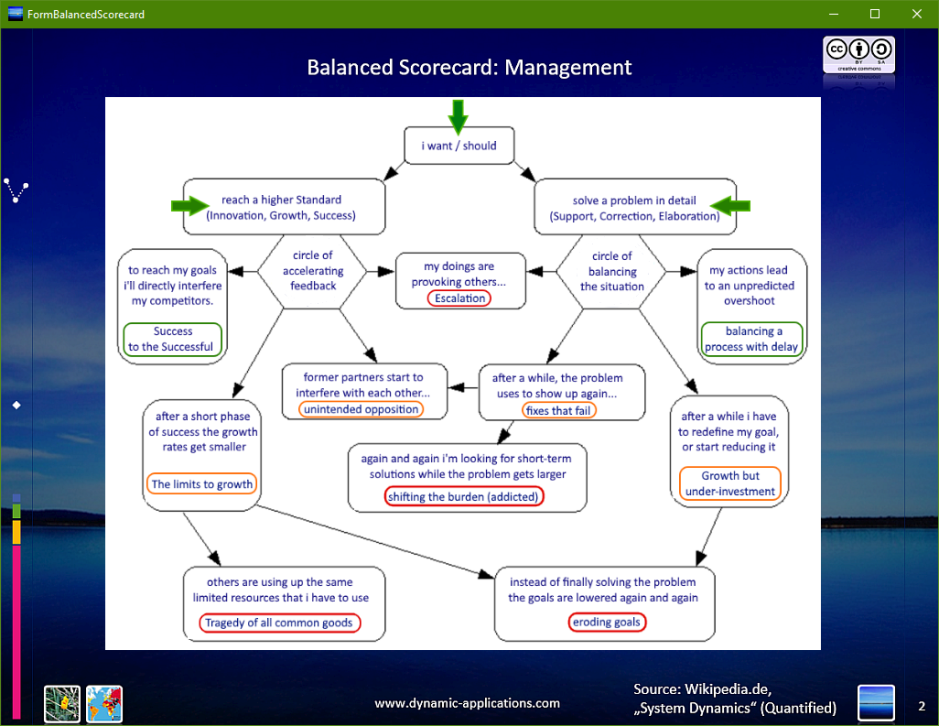
For everyone new to the topic, a simple overview of the basic feedback loops that are common to Business Model Generation as well can be found on Wikipedia’s article about System Archetypes. As well, the basic picture of those interacting Problems-and-Success Models can be found within each Dynamic Application.

Building World Models, altogether. A great topic to discuss.

I found that management picutre on German Wikipedia, translated the picture to English, called it “Balanced Scorecard – Management”, and added that picture to the top right icons in Dynamic Applications. Finally, i’ve uploaded it to the english article on System Archetypes at Wikipedia. Where it resides until today.

How could such archetypes or “building blocks” be incorporated with Dynamic Applications? – your suggestions are highly appreciated.

For everyone interested in more detailed building blocks, see PDF Attachment at the bottom of the article by @YoungModeler, reblogged below.

Angelika Schanda's avatarYoung Modeler

By Wang Zhao
Located in Lisbon, Portugal
European Master in System Dynamics candidate 2017-2019


Modellers face a problem: Too few of their models ever get reused. Meanwhile, many projects start by building a new model from scratch requiring plenty of research to conceptualize the model structure. If we see these two aspects from the perspective of ‘supply’ and ‘demand’, is there any ‘mismatch’ in between that hinders models from reuse? If so, what could be the reason?

Most system dynamics models

View original post 802 more words

infinity Performance.

for Romy Madley Croft.

Dynamic Applciations - Logo

If I scream at the top of my lungs, will you hear what I don’t say?
If I dance like I’m on a stage, will you see I seem out of place?

Continue reading “infinity Performance.”

Consent for Better and Faster Decisions.

Very interesting thoughts about reaching a Consensus based on fairness so that everyone in a Team is willing to participate and work on or with the results, as they believe in the participation culture.

it’s rare for an inventor to meet people where you instantly see they have more or alternative thoughts to what you offer yourself, so finally, a true source of inspiration.

my personal recommendation.

Robert Koshinskie's avatarringbolt consulting services

While exploring governance in business over the past couple of years I encountered both Sociocracy and Holacracy.  Both of these approaches to governance have been associated with self-directed groups, and both have wrongly been identified as forms of anarchy.  I’ve read about these approaches, attended introductory workshops, and participated in discussion groups –  but I don’t claim expertise (I’m not a trained facilitator in either Sociocracy or Holacracy).   I have applied some of what I’ve learned in daily practice, particularly consent decision-making which I feel can lead to better and faster decisions.

What is Consent Decision-Making and Why Use It?

The basic idea behind consent decisions (aka formal consensus) is that the consent process splits-the-difference between autocratic decisions that are quickly mandated, and endless debate as can be encountered in group consensus decision-making:

View original post 525 more words

der Buchladen.

Der Buchladen.

appdeveloper_logo_48x48

Eine kleine Novelle der Zeit von Martin Bernhardt.

Kennen Sie das? – iPad. Irgendwann probieren Sie dann doch mal iBooks aus. Und auf einmal verstehen Sie – das ist genau wie mit der e-Mail und dem elektronischen Kalender: es ist super gemacht.

Der Untergang, er kommt mit leisen Schritten.

Aber wovon spreche ich denn da überhaupt?

Continue reading “der Buchladen.”